EaterIQ vs Yuka: Which Food Scanner App Should You Choose?
Making healthier food choices isn't always as simple as reading the front of a package. Claims like "natural," "high in protein," or "low fat" can be helpful, but they don't always tell the complete story. The real details are hidden in the nutrition label and ingredient list.
That's why food barcode scanner apps have become popular. Instead of trying to decode long ingredient lists yourself, you can scan a product and instantly learn more about what's inside.
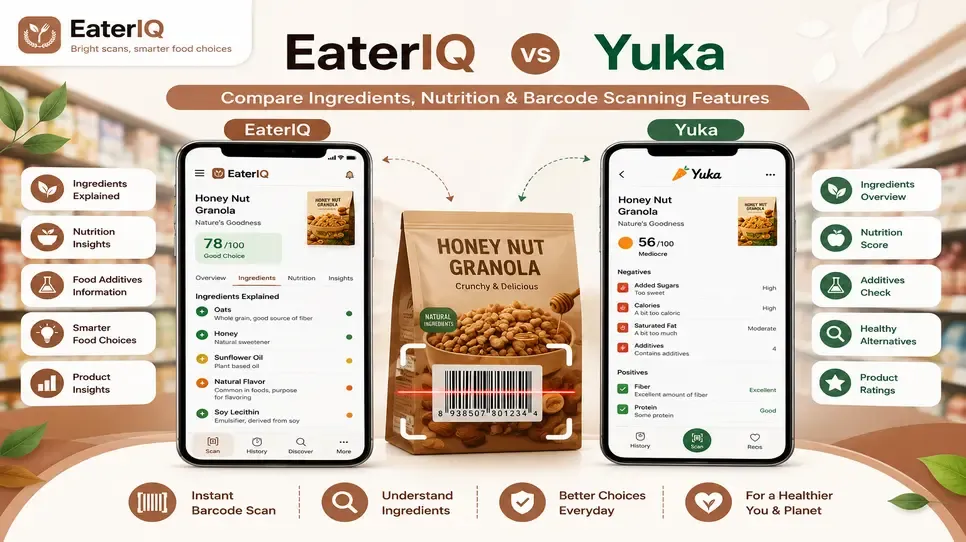
Two apps that frequently come up are EaterIQ and Yuka. Both are designed to help shoppers make more informed choices, but they take different approaches. While one focuses on educating users about ingredients and nutrition, the other emphasizes quick product ratings.
In this guide, we'll compare EaterIQ vs Yuka, explore their key differences, and help you determine which app best fits your shopping habits. If you're new to food scanning, you can also explore EaterIQ's Food Barcode Scanner to see how barcode scanning works in everyday grocery shopping.
What Is EaterIQ?
EaterIQ is a food barcode scanner that helps people better understand packaged foods by explaining ingredients and nutrition labels in simple language.
Instead of simply displaying numbers or assigning a single health score, EaterIQ focuses on education. After scanning a barcode, users can learn what individual ingredients are, why manufacturers use them, and how they contribute to the overall product.
Whether you're comparing breakfast cereals, snacks, beverages, or frozen meals, EaterIQ makes ingredient lists easier to understand. You can also use its Ingredient Checker to quickly review unfamiliar ingredients while shopping.
What Is Yuka?
Yuka is a well-known food and cosmetic scanner that evaluates products using an overall score.
The app considers nutritional quality, food additives, and other criteria to generate a simple rating that shoppers can understand at a glance. It also recommends alternative products with higher scores when available.
For users who want quick shopping decisions without reading detailed nutrition labels, this approach can be convenient.
EaterIQ vs Yuka: Quick Comparison
Feature | EaterIQ | Yuka |
Barcode Scanner | ✅ | ✅ |
Ingredient Explanations | ✅ Detailed | Basic |
Nutrition Facts | ✅ | ✅ |
Food Additive Information | ✅ | ✅ |
Product Rating | Educational approach | Overall score |
Nutrition Label Insights | ✅ Comprehensive | Moderate |
Learning Resources | Excellent | Good |
Cosmetic Scanner | ❌ | ✅ |
Beginner Friendly | ✅ | ✅ |
Ingredient Analysis
Understanding ingredients is one of the biggest reasons people use food scanner apps.
EaterIQ
Rather than labeling ingredients as simply "good" or "bad," EaterIQ explains:
What each ingredient is
Why it's included
Whether it's naturally derived or processed
Foods where it's commonly found
General nutritional context
This helps shoppers gradually become more confident at reading food labels on their own.
If you'd like to learn even more about unfamiliar ingredients, check out our guide on Food Additives Explained, where we break down common additives found in packaged foods.
Yuka
Yuka places greater emphasis on overall product scores.
While it provides information about additives, its primary focus is helping users make quick purchasing decisions instead of delivering detailed educational content.
Winner
Choose EaterIQ if you want to understand ingredients.
Choose Yuka if you prefer instant product ratings.
Nutrition Label Comparison
Both apps display essential nutrition facts, including:
Calories
Fat
Carbohydrates
Sugar
Protein
Sodium
However, how they present this information differs significantly.
EaterIQ
EaterIQ helps users understand nutrition labels by explaining what each value actually means.
For example, it provides better context around:
Added sugars
Sodium intake
Serving sizes
Protein content
Daily nutritional values
If you're still learning how to interpret food packaging, our article on How to Read Nutrition Labels offers practical tips that make shopping much easier.
Yuka
Yuka includes nutritional quality as part of its scoring algorithm, allowing users to compare products quickly without studying every nutrition fact.
Barcode Scanner Performance
A food scanner is only as useful as its product database.
Both EaterIQ and Yuka support barcode scanning, making it easy to retrieve information about packaged foods within seconds.
Product availability can vary depending on:
Country
Retailer
Local brands
Database updates
Using a reliable Nutrition Label Scanner helps shoppers compare similar products before deciding which one to buy.
User Experience
EaterIQ
EaterIQ is ideal for users who enjoy learning while shopping.
Its interface focuses on:
Clear ingredient explanations
Easy-to-read nutrition facts
Simple barcode scanning
Educational insights
Rather than rushing users toward a score, it encourages informed decision-making.
Yuka
Yuka prioritizes speed.
The app is designed for shoppers who want immediate recommendations with minimal reading.
Transparency Matters
Food scanner apps are most valuable when they explain why a product receives a certain evaluation.
Instead of encouraging users to rely solely on a score, transparent apps help explain:
Ingredient functions
Nutrition information
Food additives
Processing levels
Serving size considerations
Learning to understand food ingredients over time makes grocery shopping easier, even when you don't have your phone with you.
Real Shopping Example
Imagine you're comparing two granola bars.
Both packages advertise:
High Protein
Natural Ingredients
Healthy Snack
After scanning both products using EaterIQ's Food Barcode Scanner, you discover that one contains significantly more added sugar and multiple artificial additives.
Without scanning, those differences might not be obvious from the packaging alone.
This demonstrates why reading ingredient lists alongside nutrition labels provides a more complete picture of a product.
Pros and Cons
EaterIQ
Pros
Excellent ingredient explanations
Educational approach
Easy-to-understand nutrition insights
Beginner friendly
Helps improve label-reading skills
Cons
Does not currently scan cosmetics
Product availability depends on barcode database coverage
Yuka
Pros
Quick product ratings
Simple interface
Cosmetic scanning
Helpful alternative recommendations
Cons
Less detailed ingredient education
Product scores may not reflect every individual's dietary needs
Who Should Choose EaterIQ?
EaterIQ is a great choice if you:
Want to understand ingredients instead of relying only on scores
Frequently compare packaged foods
Read nutrition labels regularly
Want to learn about food additives
Prefer making informed purchasing decisions
Who Should Choose Yuka?
Yuka may be better if you:
Prefer simple product scores
Want quick shopping decisions
Also scan cosmetic products
Spend minimal time reviewing nutrition information
Myths vs Facts
Myth | Reality |
Food scanner apps replace nutrition experts. | They provide educational information but don't replace professional dietary advice. |
A single health score tells the whole story. | Ingredients, serving sizes, and nutrition facts all matter. |
Every food additive is harmful. | Many additives are approved for specific purposes and should be understood in context. |
Healthy packaging always means healthy food. | Marketing claims should always be verified by reading the ingredient list and nutrition label. |
Tips for Using Food Scanner Apps
To get the most value from any food scanner:
Compare similar products instead of scanning only one item.
Read serving sizes carefully.
Don't focus only on calories.
Review ingredient lists alongside nutrition facts.
Learn what unfamiliar ingredients actually do.
Use food scanner apps as learning tools rather than relying entirely on product ratings.
Frequently Asked Questions
Is EaterIQ better than Yuka?
It depends on what you're looking for. EaterIQ is better for users who want detailed ingredient explanations and nutrition education, while Yuka is ideal for shoppers who prefer quick product ratings.
Can both apps scan food barcodes?
Yes. Both apps allow users to scan packaged food barcodes to access nutrition and ingredient information.
Does EaterIQ provide ingredient explanations?
Yes. EaterIQ focuses on helping users understand what ingredients are, why they're used, and how they fit into a balanced diet.
Does Yuka scan cosmetics?
Yes. In addition to food products, Yuka also supports cosmetic barcode scanning.
Can food scanner apps replace reading nutrition labels?
No. They make nutrition labels easier to understand, but reviewing the ingredient list and serving size is still recommended.
Conclusion
Both EaterIQ and Yuka make grocery shopping easier, but they serve different types of users.
If your goal is to build a better understanding of ingredients, nutrition labels, and food additives, EaterIQ offers a more educational experience. Its focus on explaining food rather than simply scoring it helps users make confident decisions over time.
On the other hand, if you want fast product ratings and cosmetic scanning, Yuka remains a solid option.
Whichever app you choose, using a food barcode scanner is a smart way to look beyond marketing claims and better understand the products you bring home.