Behind the Scenes: How Eat IQ Analyzes Ingredients in Seconds
Behind the Curtain: How EaterIQ Assesses Ingredients in Seconds
Every time you grab a packaged food item at the store, you face a wall of fine print: nutrition labels, ingredient lists, and, often, misleading or confusing health claims. Decoding all of this information in the moment can be exhausting—even for expert nutritionists. That’s why Eat IQ was created: to help you more quickly, more accurately, and more confidently understand what you are actually eating. But how can the app decode an ingredient list in a matter of seconds? Here is a behind-the-scenes look.
Food labels are complicated. With minuscule-sized text, health warnings, and long lists of ingredients, the average person has no idea if a product truly is healthy or if it just rightly claims so. Now, that's where EaterIQ comes in.
Our mission is simple: clear, quick, and trustworthy nutrition. But the question is, how does EaterIQ assess food in seconds? Let us lift the curtain a bit and explain some of the technology that goes behind it all—without spilling any trade secrets.
By blending machine learning with nutrition science, EaterIQ makes food labels easier to understand—so you spend less time decoding and more time making confident choices.
Step 1. Scan and Recognize
What is exciting is that the process starts when you scan a food barcode or look up a product.
EaterIQ connects to a global food database that has millions of assets with updated nutrition data.
If you scan an item that isn't in the database, our OCR (Optical Character Recognition) system will read the ingredient label even from the packaging.
Advanced AI vision models are used to detect difficult ingredients, alternative names, or even unidentified additives in ingredients.
So, in a nutshell, we digest what may take you minutes to read in milliseconds.
Step 2. Ingredient Analysis using AI
Now, as far as the process is concerned, we have the ingredient list, and the real magic begins.
Our machine learning models are trained on hundreds of food labels, which lets support systems figure out patterns that are oftentimes missed by humans.
Additionally, each ingredient is checked against nutrition science research, a list of allergens, and food regulations.
Additives, preservatives, and E-numbers are checked automatically so you know exactly what is in the food.
This is the most important step to finding hidden risks such as artificial sweeteners, too much sodium, and allergens hidden in illegitimate nomenclature.
Step 3: Allergen and Sensitivity Identification
Allergy and sensitivity issues are often the biggest concerns for many eaters.
EaterIQ uses a layered approach to allergen identification:
Identifies common allergens such as gluten, milk, nuts, soy, sesame, and mustard.
Identifies allergens that can be hidden (e.g., casein in dairy, malt extract in barley).
Allows users to customize alerts based on their diet.
This means you're not just getting generic information—you're getting information that is relevant to you.
Step 4: Health Score
Numbers don't lie—sometimes they just make things easier.
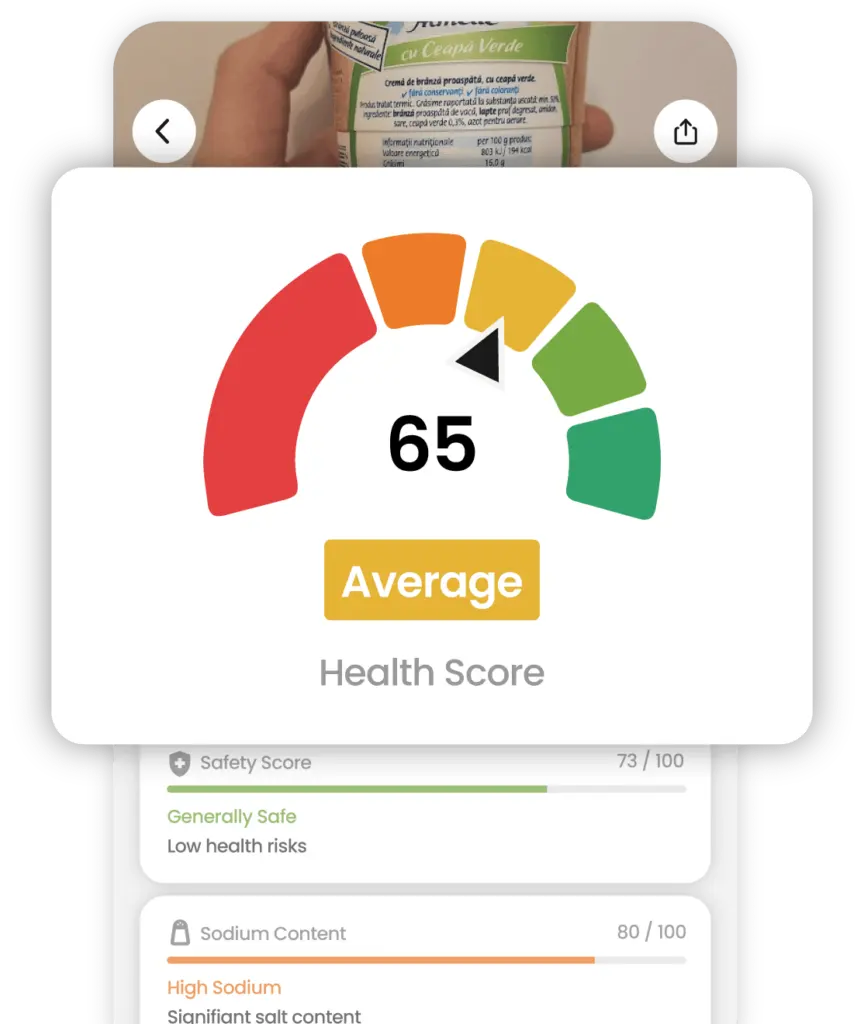
EaterIQ takes complicated nutrition information and simplifies it into an easy-to-understand score from 0 to 100. Of course, the higher the score, the more in line it is with healthy eating.
The score is based on:
Balance of nutrients (protein, fiber, and vitamins versus sugar, sodium, and saturated fats)
Quality of ingredients (whole foods versus processed additives)
Allergen safety, including any potential hidden risks, is important to consider.
Compatibility with diets (keto, vegan, DASH, Mediterranean, etc.)
This means you can look at one number and know immediately if the product helps you reach your goals.
Step 5: Personalized Insights & Ratings
Perhaps the most powerful feature is personalization. Eat IQ leverages your dietary profile, allergy settings, and health goals to craft a tailored guide for every product. If you’re avoiding gluten, the app will flag traces lurking in sauces or snacks. If you’re watching your salt, Eat IQ highlights sodium-heavy items even when their marketing appears “healthy.”
For every scanned product, Eat IQ displays a simple health rating and actionable feedback:
“A good fit for your low-fat diet.”
“Contains hidden sugars—use in moderation.”
“Allergen detected: milk protein.”
You can save preferences, sort lists, and build shopping plans based on unbiased nutrition rather than brand buzz.
Conclusion
The EaterIQ isn’t simply a food scanner; it’s a nutrition assistant. We are changing the way consumers interact with food labels by relying on AI technology, global food databases, and advanced allergen detection.
The next time you reach for a product, let EaterIQ be your right hand. Eating well should be easy, quick, and worry-free.